

Foreign Ownership of Corporations in the Philippines
Yes, foreigners can own corporations in the Philippines, but the extent of foreign ownership is subject to constitutional, statutory, and regulatory restrictions. As a general rule, foreign ownership is allowed unless the business activity is expressly restricted by the Constitution, special laws, or the Foreign Investment Negative List (FINL).
This guide explains foreign ownership of corporations in the Philippines under constitutional, statutory, and regulatory frameworks applicable in 2026.
The percentage of allowable foreign equity depends on:
- the nature of the business,
- whether the activity is domestic market or export-oriented, and
- compliance with capitalization and ownership rules.
This issue is central not only to corporate practice but also to bar examinations, as it tests constitutional economic provisions, statutory interpretation, and corporate structuring principles.
General Rule: Foreign Ownership Is Allowed, Subject to Exceptions
Under the Foreign Investments Act (FIA), as amended by RA 8179 (1996) and RA 11647 (2022), foreign investors may own up to 100% of a Philippine corporation unless the activity is restricted.
Compliance with foreign ownership rules is assessed during incorporation and amendments by the Securities and Exchange Commission (SEC), which implements corporate registration and ownership disclosure requirements.
Restrictions arise from:
- the 1987 Constitution,
- special laws, and
- the Foreign Investment Negative List (FINL).
The FINL is periodically updated and enumerates:
- activities reserved to Filipinos, and
- activities subject to foreign equity caps.
100% Foreign-Owned Corporations: When Are They Allowed?

A corporation may be 100% foreign-owned if it is engaged in a business not listed in the FINL and not restricted by law.
Common examples include:
- export-oriented enterprises,
- IT and technology services,
- consultancy and support services,
- certain manufacturing activities.
In such cases:
- registration is made with the SEC, and
- the SEC cannot impose additional restrictions beyond what the law provides (RA 11647, Sec. 5).
However, capitalization requirements may still apply, particularly for domestic market enterprises.
Partially Foreign-Owned Corporations (Equity Caps)
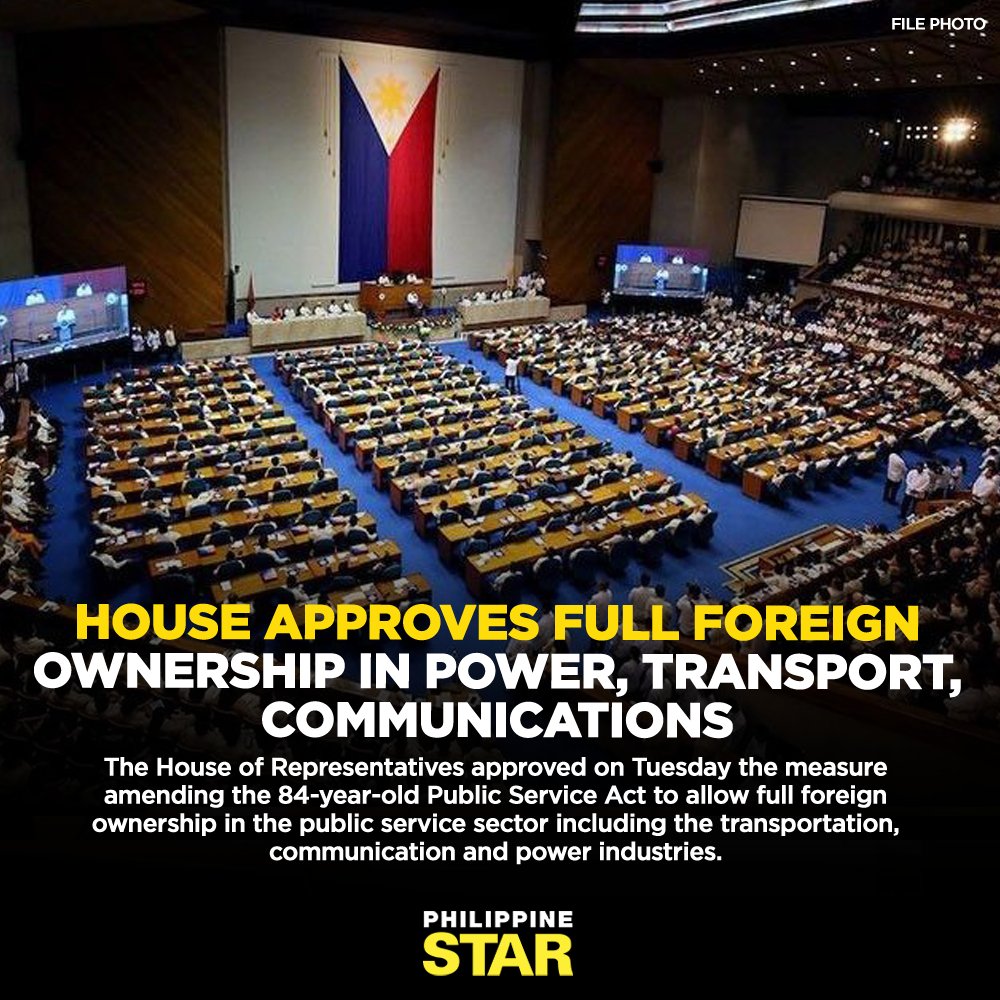
Some industries impose a foreign equity limit, commonly 40%, requiring at least 60% Filipino ownership.
This rule applies to sectors such as:
- public utilities and public services,
- landholding corporations,
- mass media,
- exploitation of natural resources.
In Gamboa v. Teves, G.R. No. 176579, June 28, 2011, the Supreme Court clarified that compliance is measured not only by nominal shareholding but also by:
- voting rights, and
- beneficial ownership.
Capitalization Requirements for Foreign-Owned Corporations

Foreign ownership often triggers minimum capital requirements, especially for domestic market enterprises.
As a general rule:
- foreign-owned domestic market enterprises must have minimum paid-in capital of USD 200,000.
This rule has been affirmed in Initiatives for Dialogue v. Senate, G.R. No. 184635 and G.R. No. 185366, June 13, 2023 and codified under RA 11647.
After incorporation, capital contributions and ownership structure must also be properly reflected in tax registration records filed with the Bureau of Internal Revenue (BIR).
Exceptions
- Export enterprises exporting at least 60% of output may be exempt.
- Certain technology-based enterprises may qualify for reduced thresholds, subject to proof and compliance.
For a detailed discussion of capitalization thresholds, paid-up capital rules, and common structuring mistakes, see our guide on Choosing the Right Business Structure in the Philippines (2026 Guide)
Land Ownership and Foreign Corporations

As a constitutional rule:
- only Filipino citizens or
- corporations with at least 60% Filipino ownership
may own land in the Philippines.
Foreigners:
- may lease land, but
- may not own land directly or indirectly.
Attempts to circumvent this rule through layered ownership structures are scrutinized using the control test and grandfather rule, as discussed in Narra Nickel Mining v. Redmont.
Retail Trade and Other Special Sectors
Retail trade is governed separately under RA 11595, which requires:
- ₱25 million minimum paid-up capital for foreign retailers, and
- compliance with additional operational requirements.
Retail is one of the most commonly misclassified activities, leading to regulatory exposure after incorporation.
Common Pitfalls in Foreign Ownership Structuring
- Assuming 100% foreign ownership is always allowed
- Ignoring the FINL or special laws
- Failing to meet minimum capital requirements
- Using nominee arrangements
- Treating SEC registration as a mere formality
These errors often surface during:
- bank due diligence,
- licensing applications,
- audits, or
- shareholder disputes.
Frequently Asked Questions (FAQ – 2026)
Can foreigners own 100% of a corporation in the Philippines?
Yes, if the business activity is not restricted by the Constitution, special laws, or the FINL.
What is the usual foreign ownership limit in restricted industries?
Most restricted sectors allow up to 40% foreign ownership, with at least 60% Filipino ownership required.
Does foreign ownership affect capital requirements?
Yes. Foreign-owned domestic market enterprises generally require USD 200,000 minimum paid-in capital.
Can foreigners own land through a corporation?
Generally no. Land ownership is subject to strict constitutional limits, including indirect ownership structures.
Does foreign ownership affect SEC approval?
Yes. The SEC reviews ownership, capitalization, and compliance with the FINL at incorporation and during amendments.
Can a foreign-owned corporation later change ownership structure?
Yes, subject to SEC approval and continued compliance with ownership and capitalization rules.
Foreign ownership is not an SEC paperwork issue — it is a constitutional and statutory compliance issue. Getting it wrong at incorporation often leads to costly restructuring later.
This guide is written by Romualdez Law Offices, a BGC-based law firm assisting local and foreign entrepreneurs with business registration, compliance, and corporate structuring in the Philippines.
Every case is different. If you’re dealing with a custody, corporate, or immigration issue, you may book a consultation with our office to assess your legal options properly.
Schedule a Consultation
Location
Soho 207 Mckinley Park Residences, 3rd ave. cor. 31st St., BGC, Taguig, Philippines, 1635
Email: executive@romualdezlaw.com
Contact Number: +63 952 489 1738
Pingback: Authorized Capital vs Paid-Up Capital in the Philippines (2026 Legal Guide) - Romualdez Law Offices
Pingback: Amend Articles of Incorporation Philippines (2026 Legal Guide & Compliance Checklist) - Romualdez Law Offices
Pingback: Minority Shareholder Rights Philippines (2026 Legal Guide) - Romualdez Law Offices
Pingback: Corporate Housekeeping Philippines (2026 Compliance Guide) - Romualdez Law Offices